Bay Area Reporter looks back on 55 years
by Joe Siegel
SAN FRANCISCO — The staff of San Francisco’s Bay Area Reporter reflected on the publication’s five and a half decades of news coverage at the annual convention of NLGJA: The Association of LGBTQ+ Journalists in San Francisco, which was held September 10-12, 2026.
The B.A.R. was launched as a biweekly in April 1971 by then-publisher Bob Ross. Among the many LGBTQ stories the paper has reported on were the AIDS epidemic in the 1980s, the murder of civil rights pioneer Harvey Milk, and the battle for marriage equality in the state of California.
Jim Provenzano, the paper’s veteran arts and nightlife editor, discussed the inclusion of obituaries of those who died of AIDS, the paper’s HIV columnists, and the reviews of theater, music, and porn films.
Among the first writers was Marcos Hernandez, who became the paper’s first leather columnist. Milk also had written a political column for the paper.
Provenzano noted Ross had a “deep connection” with the city’s LGBTQ community and the B.A.R., which was initially a “gossip paper,” soon became a “go-to source” for readers.
At the time, the staff didn’t have access to modern equipment to produce the paper.
“Everything was done by hand,” Provenzano noted.
“We adapted new technology to stay current and relevant,” added current publisher Michael Yamashita. “We learned early not just to jump on the bandwagon. Things are developing very quickly.”
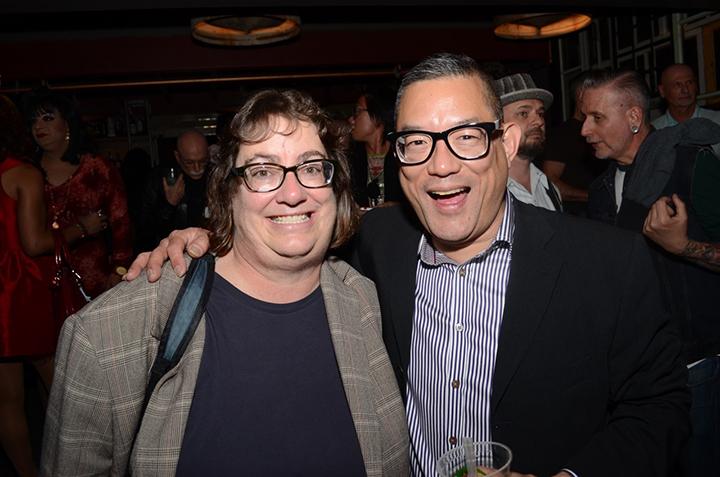
News editor Cynthia Laird, who joined the paper as a staff writer in 1996, found the world of LGBTQ news very lively.
“There was a lot going on,” Laird recalled. Among the big stories at the time were protease inhibitors, which were used to treat HIV positive individuals, were introduced as well as the federal funds to provide medical care and support for people living with HIV, otherwise known as the Ryan White Care Act.
Laird said the paper provides balanced coverage when reporting on politics. “We try to talk to all the candidates in a race. We won’t single out the LGBT person or the person that may have a better chance at winning. We don’t know what the voters are going to decide. Endorsements are totally separate from our news coverage. We do endorsements as a total separate process.”
The B.A.R. does not shy away from covering controversies involving members of the LGBTQ community.
“We covered a bar in the Castro which was accused of discrimination [against] people of color, I think it was back in 2005,” Laird said. “And the owner of that establishment was a gay man and he took one of the most unusual tactics I have ever seen. He ran full-page ads every week in our paper to deny the charges and promote his bar. And here we were, covering the latest protest at the bar. It was really interesting. He chose to spend a lot of money with us even though we were covering this very negative story [about] him.”
All the panelists noted that the legacy of the B.A.R. will not be forgotten thanks to the work of volunteers. “We went through our old archives, from 1971 to 2005, all were digitized by the GLBT Historical Society which is a wonderful resource,” said Laird. “They’re on the Internet Archive. You can search them and it’s really valuable.”
IN THE NEWS
Volume 28
Issue 9